
How to Get a Nonspeaking Toddler to Start Communicating: 3 Strategies From an SLP
From Dr. Kekejian — Lead SLP and Professor
If your toddler isn’t talking yet, “just wait, they’ll grow out of it” is probably the last thing you want to hear. As a pediatric speech-language pathologist, my honest answer is more useful than that: a nonspeaking toddler doesn’t need more words said at them — they need more reasons and more chances to communicate, in whatever form they can right now. Words are often the last piece to click into place, not the first.
Disclosure: This post contains Amazon affiliate links. As an Amazon Associate, I earn from qualifying purchases at no extra cost to you.
To help a nonspeaking toddler start communicating, follow their lead in play, build in pauses so they have to initiate, honor all forms of communication (reaching, pointing, sounds, gestures) as real communication, and pair every word you say with a gesture or visual. If there’s no progress in communication attempts — verbal or nonverbal — by 18 months, or your child isn’t using gestures like pointing or waving by 12–15 months, an evaluation is worth scheduling sooner rather than later.
Here are 3 strategies I use in sessions and recommend to parents every week, with a tip for putting each one into practice today.
Follow Their Lead Instead of Redirecting
Kids communicate more when they’re already interested in something. Chasing your toddler’s attention toward flashcards or “teaching moments” usually backfires — it turns communication into a demand instead of an exchange.
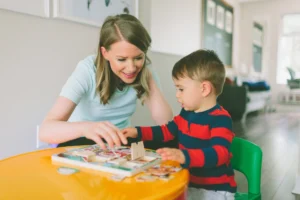
Try this: Get down on the floor and join whatever they’re already doing, even if it’s just banging blocks together. Comment on it, imitate it, and wait to see if they respond to you being there.
Build in Pauses (Communicative Temptations)
This is one of the most powerful tools in speech therapy, and it costs nothing: create a moment where your child has to do something to get what they want, instead of you handing it over automatically.
Try this: Put a favorite snack or toy somewhere they can see it but not reach it. Wait. Any response — a reach, a look at you, a sound — is a communication attempt worth celebrating and immediately rewarding.
Count Every Form of Communication, Not Just Words
A common mistake is waiting for spoken words before responding to a child’s communication. If your toddler isn’t talking yet, gestures, eye contact, sounds, and even leading you by the hand are the building blocks words are made of.
Try this: When your child points, pulls you toward something, or makes a sound with intent, respond right away and label it (“Oh, you want the ball!”). Treating gestures as real communication makes a child more likely to keep communicating — and eventually add words on top.
Use Toys Built for Cause-and-Effect and Turn-Taking
Toys that respond instantly to a child’s action are useful because they make the “want more” feeling concrete and repeatable — a natural setup for requesting.
The Fat Brain Toys SpinAgain is one I recommend often for this age. Stacking and spinning the discs gives an immediate, satisfying result, which makes kids want to repeat the action — a perfect setup for a request like “go,” “more,” or reaching for your hand to help.
Try this: Do the first spin yourself, then hold the next disc just out of reach and wait for your child to reach, look at you, or vocalize before you help. That pause is doing the real work.
Watch a Real Example
Reading about these strategies is one thing — seeing them in action is another. This video walks through what it actually looks like to draw out communication from a nonspeaking toddler: Video Resources at SoCal Speech
When to Seek an Evaluation
These strategies support communication development, but they aren’t a substitute for an evaluation if you have concerns. Some signs it’s worth talking to a speech-language pathologist sooner rather than later:
No consistent gestures (pointing, waving, reaching to show) by 12–15 months
No words, including approximations, by 18 months
Loss of words or skills your child previously had, at any age
Little to no eye contact or interest in back-and-forth interaction
You’ve been trying these strategies consistently and aren’t seeing any movement, verbal or nonverbal
An evaluation doesn’t commit you to anything — it just gives you clarity and a plan.
Frequently Asked Questions
What’s the first sign a nonspeaking toddler is starting to communicate?
Usually it’s not a word — it’s an intentional gesture or sound aimed at getting your attention or a response, like reaching toward something while looking at you, or making a consistent sound to request the same thing each time.
Is it normal for a 2-year-old to not be talking at all?
Some late talkers catch up on their own, but by age 2 most toddlers are using at least a handful of words. A 2-year-old with no words and few gestures is generally worth having evaluated, since earlier support tends to make a bigger difference.
What’s the difference between a “late talker” and a speech delay?
A late talker typically has strong understanding, gestures, and social communication, and is just behind on spoken words. A broader speech or language delay usually involves gaps in understanding, gesture use, or social interaction too — which is part of why an evaluation, not a guess, is the way to tell the difference.
Final Thoughts: Trusting Your Intuition as a Parent
At SoCal Speech-Language Therapy, we’re the experts on childhood speech and language milestones. Together, we build a plan that’s realistic for your family and grounded in real results.
Early intervention matters — the sooner a speech-language pathologist gets involved, the easier it is to support your child’s natural communication growth.
Schedule a free consultation call with SoCal Speech-Language Therapy to talk through your toddler’s communication development and how our pediatric SLPs can help.
Schedule a Free ConsultationAbout the Author
Dr. Carla Kekejian, PhD, CCC-SLP, is the founder of SoCal Speech-Language Therapy and a professor of communication disorders and sciences at California State University, Northridge (CSUN). With over a decade of clinical experience, she specializes in bilingual speech therapy and strengths-based communication support for children in La Cañada Flintridge and across the Greater Los Angeles area, with a focus on evidence-based, culturally responsive care. Read Dr. Kekejian’s full bio, or learn more about her research and teaching.
Medical Disclaimer
The information here is for education and doesn’t replace professional medical advice or a diagnosis. Always talk to your doctor or a qualified health provider with questions about a medical condition.