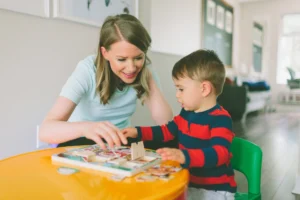

How to Teach Your Toddler to Answer “Wh-” Questions: 3 SLP-Approved Strategies for Parents
From Dr. Carla Kekejian — Pediatric Speech-Language Pathologist, CCC-SLP · September 25, 2026
If you ask your toddler “What’s that?” or “Where’s your shoe?” and get a blank stare, a repeated word, or no response at all, you’re not alone. Answering “wh-” questions — who, what, where, when, and why — is a skill toddlers build gradually, and it depends on both understanding language and being able to organize a response. The good news is that this skill can be taught through simple, playful moments woven into your day.
This post contains affiliate links. If you make a purchase through one of these links, we may earn a small commission at no additional cost to you.
Why “Wh-” Questions Matter for Toddler Development
Below, a pediatric speech-language pathologist (SLP) shares three practical strategies to help your toddler start answering “wh-” questions with confidence, plus a toy that turns this skill into a game.
“Wh-” questions ask children to do more than just listen — they require understanding the question word itself, searching memory or the environment for the answer, and putting that answer into words. This skill underlies conversation, classroom participation, and reading comprehension down the line. Children typically begin answering simple “what” and “where” questions first, with “who,” “when,” and “why” developing later as language and reasoning skills mature.
Start With “What” and “Where” Before “Why”
“Wh-” questions develop in a predictable order, and starting with the easiest ones sets your child up for success. Begin with concrete questions tied to something visible, like “What is this?” while pointing to an object, or “Where’s the ball?” during play. Save more abstract questions like “why” and “when” for later, once your child is consistently answering the simpler ones.
Try this: During daily routines, ask one simple “what” or “where” question at a time, and pause to give your child time to respond before offering the answer yourself.
Use Search-and-Find Play to Build the Skill Naturally
Games built around finding a hidden object are one of the most effective ways to teach “where” questions, because the question and the answer happen in real time, with a clear visual payoff.
The Where’s Bear? The Hide and Find Stacking Block Game turns this exact concept into play: your child hides and searches for Bear among the stacking blocks, giving you dozens of natural chances to ask “Where’s Bear?” and celebrate together once he’s found. Because the game can be replayed again and again, your child gets repeated practice answering the same question type in a way that feels like a game, not a drill.
Try this: While playing, ask “Where’s Bear?” and wait expectantly. If your child doesn’t answer, model it yourself (“Bear is under the block!”) and try again on the next round.
Model the Answer, Then Fade Your Support
If your child doesn’t answer a question, resist repeating the same question louder or more insistently. Instead, model a short answer for them, then ask again a few moments later so they have a chance to imitate or attempt it independently.
This approach, often called a model-and-fade strategy, gives your child the language they need without pressure. Over time, you can reduce how much of the answer you provide, letting your child fill in more of it themselves.
Try this: Ask the question, wait 5 seconds, then model a simple answer if needed. Revisit the same question later in the day to give your child another chance to answer on their own.
See These Strategies in Action
Reading about these strategies is a great starting point, but watching them modeled during real play can make them much easier to bring into your daily routine. Our team has put together video demonstrations showing exactly how these techniques look in action.
Watch the video demonstrations on our Video Resources page →
Frequently Asked Questions
At what age should toddlers start answering “wh-” questions?
Most toddlers begin answering simple “what” and “where” questions between 24 and 30 months, with “who” questions following shortly after. “Why” and “when” questions are more abstract and typically develop between ages 3 and 4, as reasoning and language skills mature.
What if my toddler repeats my question instead of answering it?
Repeating a question instead of answering it (called echolalia) is common in early language development. Respond by modeling the correct answer in a short phrase, without pointing out the repetition, and give your child continued low-pressure opportunities to practice.
Can toys really help teach “wh-” question skills?
Yes. Interactive search-and-find games, like the Where’s Bear? Hide and Find Stacking Block Game, create a natural back-and-forth where a question leads directly to a visible answer. This structure helps toddlers connect the question word to a concrete response, which builds the foundation for answering more abstract questions later.
When should I be concerned about my toddler’s question-answering skills?
If your toddler is not attempting to answer simple “what” or “where” questions by age 2.5 to 3, or shows broader delays in following directions or using words, it’s worth having a licensed speech-language pathologist evaluate them. Early support leads to stronger long-term communication outcomes.
The Takeaway
“Wh-” questions are a building block for conversation, comprehension, and later academic skills — and they can be taught through simple, playful practice at home. Start with easier question types, use search-and-find games to make practice natural, and model answers before expecting your child to respond independently. Small, consistent moments of practice add up to real progress.
Have Questions About Your Child’s Language Development?
If you have questions about your child’s language development or want personalized home practice strategies, reach out to our team — we’re here to help.
Contact UsAbout the Author
Dr. Carla Kekejian, PhD, CCC-SLP, is the founder of SoCal Speech-Language Therapy and a professor of communication disorders and sciences at California State University, Northridge (CSUN). With over a decade of clinical experience, she specializes in bilingual speech therapy and strengths-based communication support for children in La Cañada Flintridge and across the Greater Los Angeles area, with a focus on evidence-based, culturally responsive care. Read Dr. Kekejian’s full bio, or learn more about her research and teaching.
Medical Disclaimer
The information here is for education and doesn’t replace professional medical advice or a diagnosis. Always talk to your doctor or a qualified health provider with questions about a medical condition.